Cryptomaidav Basics
Wallets and Custody: Who Controls the Keys?
Exchange, app or hardware wallet: how the custody of crypto assets works, what a private key is and how to protect your recovery phrase.
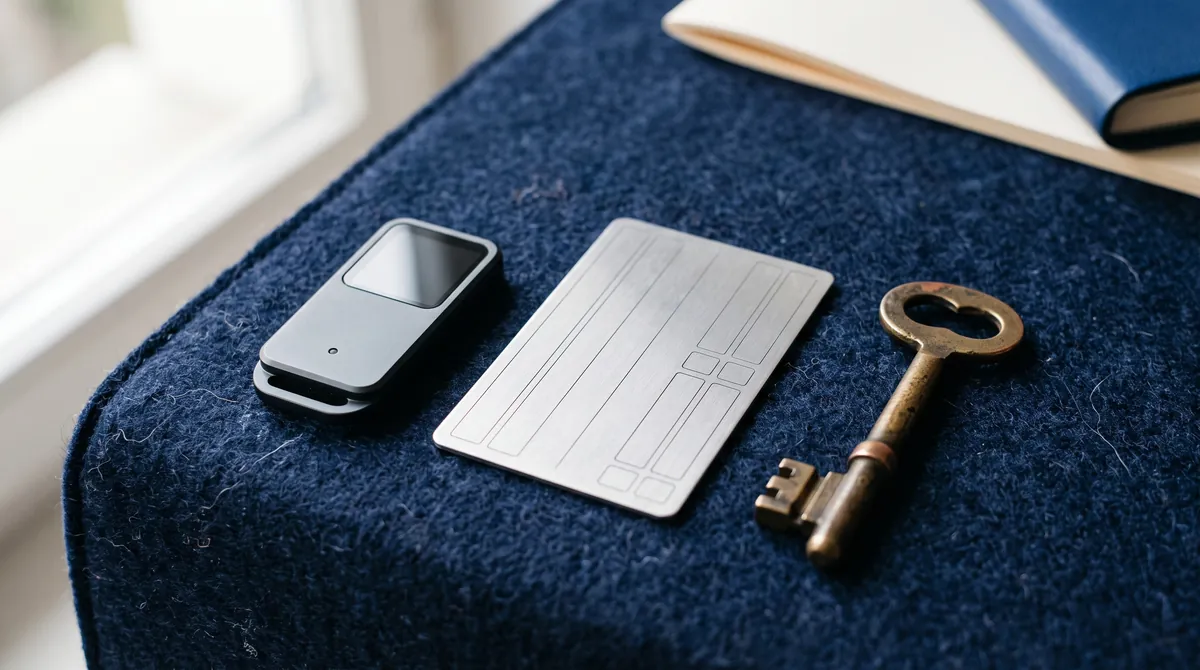

Strictly speaking, anyone who owns crypto-assets owns something else: the ability to control entries in a public ledger. That ability depends on a private key. This article explains what keys, addresses and signatures are, how custody by a provider differs from self-custody, how hot wallets, cold wallets and recovery phrases work, and how you can recognise deception attempts and plan ahead for emergencies and inheritance.
Keys, addresses and signatures
Every wallet is based on a key pair. The private key is a very large random number that must be kept secret. The public key is derived from it mathematically, and from the public key in turn the address to which others can send crypto-assets. Going the other way, from the public key back to the private key, is practically impossible according to current knowledge.
When you want to transfer crypto-assets, the wallet signs the transaction with the private key. Every node in the network can check this digital signature using the public key, without knowing the private key. The address is therefore similar to an account number that you can pass on, while the private key resembles a signature that nobody can forge as long as they do not know it.
This leads to the basic principle of custody: whoever controls the private key controls the assets. Strictly speaking, a wallet does not contain any coins, because the crypto-assets themselves are recorded on the blockchain. If the key is lost, there is no authority that can restore it. If it falls into the wrong hands, third parties can withdraw the assets irrevocably.
Custody by a provider
Many people leave their keys with a service provider, such as a trading platform or a bank. They see a balance in an app, but actual control lies with the provider. The EU’s Markets in Crypto-Assets Regulation (MiCA) calls this activity ‘providing custody and administration of crypto-assets on behalf of clients’. Since 30 December 2024 it has required authorisation, and the transitional periods expired on 1 July 2026 at the latest. In Germany, the Federal Financial Supervisory Authority (BaFin) is responsible.
MiCA requires providers to keep their clients’ holdings separate from their own and to maintain a register of positions for each client. The crypto-assets held in custody are legally segregated from the provider’s own assets, so that creditors cannot access them in the event of insolvency. The provider is liable, up to market value, for losses resulting from incidents attributable to it. There is, however, no deposit guarantee scheme of the kind that protects savings.
The advantage of this solution is convenience: a forgotten password does not automatically mean a loss, and the provider takes care of the technology. The disadvantage is dependence, because you rely on the provider working carefully and carrying out withdrawals. Whether a provider is authorised can be checked in BaFin’s company database and in the register of the European Securities and Markets Authority (ESMA).
Self-custody with hot and cold wallets
With self-custody, you hold the private key yourself. Anyone who keeps their own crypto-assets is not providing a service that requires authorisation, because this is not done on behalf of clients. Manufacturers of wallet software or hardware do not need authorisation either, as long as they have no access to their users’ assets. Responsibility therefore lies entirely with you.
With a hot wallet, the keys are stored on a device with an internet connection, for example in a smartphone app. This is convenient for smaller amounts and frequent payments, but vulnerable if the device is infected with malware. A cold wallet, by contrast, keeps the keys offline.
The most common form is the hardware wallet, a small device that stores the private key and signs transactions internally. The key does not leave the device, even when it is connected to a computer. It is important to check the recipient address and the amount on the device’s display before you confirm.
The recovery phrase
Almost all of today’s wallets generate a recovery phrase when they are set up, often called a seed phrase. It usually follows the BIP-39 standard and generally consists of 12 or 24 words taken from a fixed list of 2,048 terms. All the keys in the wallet can be recalculated from this sequence of words, even on a different device and with different software.
The phrase is therefore the master key: anyone who knows it can take over the assets without ever having held the device. Some wallets allow an additional passphrase that is required together with the word sequence. It increases protection but must be stored just as securely, because without it the wallet cannot be restored. A simple checklist has proved its worth for safekeeping:
- Write the phrase down offline only, on paper or on a metal plate
- Keep at least two copies in separate, secure places
- Never photograph the phrase or save it in the cloud, a notes app or an e-mail
- Never tell anyone the phrase, including supposed support staff
- Update software and firmware only from the manufacturer’s official source
- Check the address and amount on the device before every confirmation
Multisignature for larger holdings
With multisignature, or multisig for short, a transaction needs the signatures of several keys. A common model is two of three: there are three keys, and two of them must approve. If one key is lost or stolen, the assets remain both protected and accessible.
For companies, the method puts the four-eyes principle into practice technically. No one can dispose of the holdings alone, and the keys can be distributed across people, devices and locations. The price is more effort in setting up, documenting and making every payment. A precise description of the configuration is essential, because recovery often requires not only the phrases but also the public keys of the other participants.
| Key A | hardware wallet held by the managing director, office |
|---|---|
| Key B | hardware wallet held by the head of finance, second location |
| Key C | backup key in a safe deposit box |
| Signatures required | 2 of 3 |
| One key is lost | access with the other two remains possible |
| One key is stolen | no transaction possible with it alone |
The example shows one possible model for a small company. After the loss of a key, the holdings are usually transferred to a newly created wallet so that there are once again three independent keys.
Recognising deception attempts
The cryptography behind wallets is considered very robust, so attackers often target people instead. BaFin warns of messages by e-mail, text message, social media or telephone in which fraudsters pose as employees of a trading platform in order to obtain login details. Typical warning signs are:
- Someone asks for your phrase or private key, which reputable providers never do
- A message creates time pressure, for instance with a supposed account freeze
- A link leads to a page whose address merely resembles the original
- An online acquaintance promises high returns without risk
- After a loss, strangers offer to recover the assets in return for an upfront payment
Planning for emergencies and inheritance
Like other assets, crypto-assets form part of an estate. Without the access details, however, heirs cannot reach them, and with self-custody there is nobody who will release access on presentation of a certificate of inheritance (Erbschein). With providers, by contrast, the process works as it does for a bank account, through proof of inheritance.
A written overview is helpful: which wallets and providers exist, where the devices are kept and how a trusted person should proceed in an emergency. The phrase itself does not belong openly in this overview but in a separate, secure place. Review the arrangements from time to time, for example when new wallets are added.
A wallet does not store coins, but the keys that control them.
Whoever controls the keys decides on security and responsibility. An authorised provider offers convenience and legal safeguards, self-custody offers independence and demands diligence, and the two approaches can be combined. How the principle works with Bitcoin is shown in the article Bitcoin Explained, and further terms are explained in the Business Glossary.
Frequently asked questions
What is the difference between a hot wallet and a cold wallet?
With a hot wallet, the keys are stored on a device with an internet connection, for example in a smartphone app. This is convenient but more vulnerable to malware and attacks. A cold wallet keeps the keys offline, usually on a hardware wallet. It is better protected against remote access but requires more effort for every transaction.
What happens if the hardware wallet breaks?
As long as you still have the recovery phrase, the device can be replaced. The phrase is used to restore the keys on a new device or in a compatible wallet, because the crypto-assets are recorded on the blockchain and not on the device. If both the device and the phrase are missing, access is as a rule lost for good.
Is there deposit protection for crypto-assets held by providers?
No. There is no deposit guarantee scheme for crypto-assets like the one that covers savings at banks. MiCA does, however, require authorised custodians to hold client assets separately from their own, so that creditors cannot access them in the event of insolvency. In addition, the provider is liable for losses attributable to it, limited to market value.
Terms
- Private key
- A secret number used to sign transactions digitally, which therefore gives control over crypto-assets.
- Recovery phrase
- A sequence of usually 12 or 24 words under the BIP-39 standard from which all the keys of a wallet can be recalculated.
- Multisignature
- A procedure in which a transaction only becomes valid once a set number of several authorised keys have signed it.
Sources
- Merkblatt Kryptowerte-Dienstleistungen nach MiCAR (in German)Federal Financial Supervisory Authority (BaFin)
- Risks in Focus 2026: Investments in cryptoassets and the influence of social media on investment behaviourFederal Financial Supervisory Authority (BaFin)
- BIP 39: Mnemonic code for generating deterministic keysBitcoin Improvement Proposals
- Securing your walletbitcoin.org
Image: illustration, created with AI.