Innovationmaidav Focus
Where AI Actually Saves Work in Mid-Sized Companies
Not promises about the future but everyday office life: the processes in which AI saves measurable time today, and how firms can start without a major project.

A great deal is promised about artificial intelligence. In mid-sized companies (the German Mittelstand), a more sober question counts: which task in the office, on the shop floor or in the warehouse gets done faster with it, without loss of quality? The answer is surprisingly concrete. Quotes, the inbox, receipts, minutes and inspection work often contain enough routine to make a trial worthwhile. This article shows the areas of use with the greatest everyday benefit, the groundwork required, a step-by-step roadmap and the legal framework.
How widespread AI is in businesses
According to Germany's Federal Statistical Office (Destatis), around 26 per cent of German companies with at least ten employees used artificial intelligence technologies in 2025. A year earlier, it was roughly one in five. The gap by size remains clear: among companies with 10 to 49 employees the share was 23 per cent, among medium-sized companies 36 per cent and among large companies 57 per cent. AI users most often relied on methods for analysing text and for generating images, video or audio.
Equally revealing is what holds back the companies that have considered AI but not yet introduced it. In this group, 72 per cent cited a lack of knowledge, 62 per cent uncertainty about the legal consequences and 60 per cent data protection concerns. Difficulties with the availability or quality of the necessary data were mentioned by 44 per cent. All four hurdles can be lowered: with knowledge, clear rules and a little order in a firm's own records.
Where time is freed up in the office
Most areas of use in the office are based on generative AI, more precisely on language models. These are AI systems that have been trained on large volumes of text and can understand, summarise and draft texts. Their strength lies wherever a lot of reading, sorting and writing is done and processes repeat themselves.
- Quotes and tenders: analysing bills of quantities, assembling suitable standard text passages and producing a first draft.
- Inbox: sorting emails and enquiries by subject and urgency and forwarding them to the person responsible.
- Incoming invoices: recognising receipts, extracting invoice data and preparing suggested bookkeeping entries for review.
- Meetings: producing minutes from notes or recordings and summarising long documents.
- Knowledge search: finding answers in the firm's own manuals, contracts and data sheets, with a reference to the source passage.
- Translations: translating correspondence, instructions and product data, then having specialists check the result.
Incoming invoices deserve a closer look. Since 1 January 2025, businesses in Germany have been required to be able to receive electronic invoices. Where a structured e-invoice arrives, the data is already machine-readable. AI-supported receipt recognition therefore helps above all with paper, scans and simple PDF files, which will continue to arrive during the transitional period. How payments are being digitised at the same time is described in our article on fintechs and banking services.
Then there are texts that have to be written again and again: product descriptions for the online shop, job advertisements, customer information. A system draft spares you the blank page; the final version stays with the specialists. Coding assistants suggest code, explain it or narrow down errors, for example in your own spreadsheet analyses. In every case, language models can produce plausible-sounding but false information, so-called hallucinations. A suggestion is therefore a starting point, not a verified solution.
Production, warehouse and purchasing
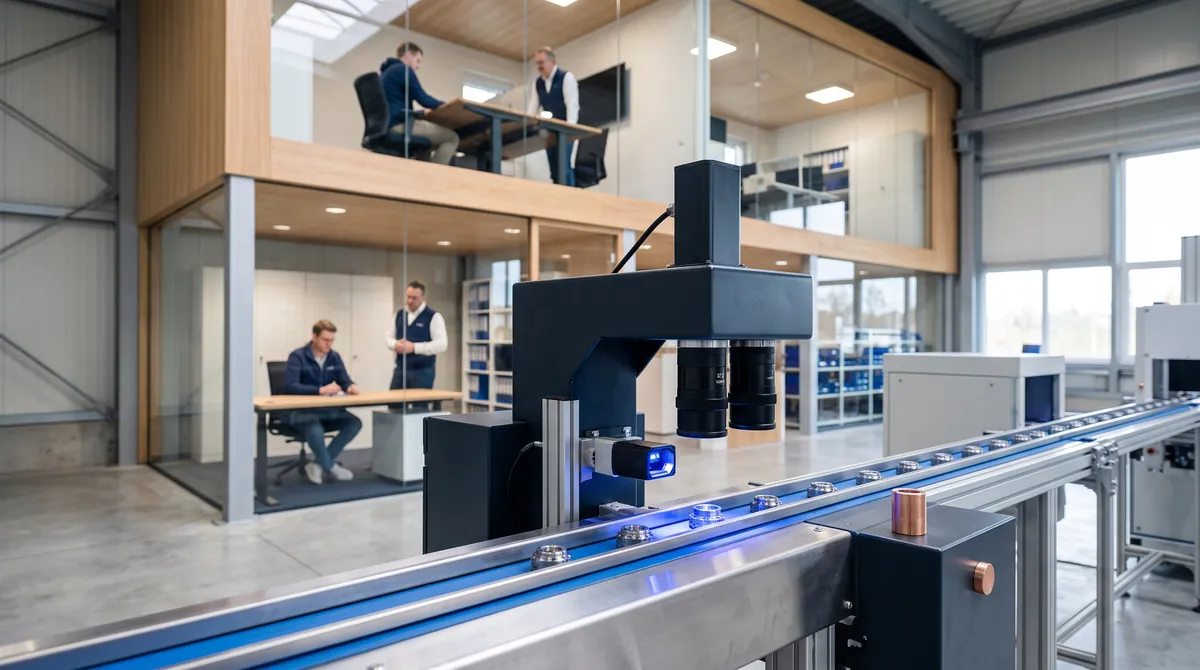
Outside the office, the benefit often lies in machine vision. Cameras on the production line record surfaces, dimensions or whether all components are fitted, and a trained model detects scratches, missing parts or deviations. The inspector can then concentrate on the conspicuous cases instead of examining every part individually. The prerequisites are even lighting, enough images of good and defective parts and a clear definition of what counts as a defect.
In the warehouse and in purchasing, demand forecasts help. Models analyse sales history, seasonal patterns and incoming orders and suggest order quantities. This can lower stock levels and make shortages rarer, with less capital tied up in goods that sit in storage for a long time. Forecasts nevertheless remain probabilities. They do not replace a conversation with the sales team about a large order that appears in no history.
What needs to be settled beforehand
AI only works as well as the material it is given. Preparing quotes automatically requires earlier quotes that can be found, well-maintained item master data and up-to-date price lists. For knowledge search, documents must sit in one place, in their current version, with clear access rights. A widely used method for this, known as retrieval-augmented generation (RAG), first searches the firm's own documents for relevant passages and only then lets the language model answer on that basis. This lowers the risk of invented information, but does not replace checking.
A clearly described process is just as important. If you do not know how an enquiry travels from the inbox to the quote today, you cannot say where a machine would help. Often, simply writing down the individual steps reveals where work is being duplicated. Some improvements then need no AI at all, just a better template.
Getting started in six steps
- Choose a process that occurs frequently, is clearly defined and in which errors become apparent early.
- Measure the time it takes today, for example per case over two weeks.
- Set up a pilot of a few weeks with few participants and clear objectives.
- Involve the employees who know the process from the outset.
- Have a person check every result and keep a record of errors.
- Decide on any expansion only after an honest evaluation.
The measurement at the start is the most important step and the one most often skipped. Without a baseline, every statement about time saved remains a gut feeling. Involving the team matters just as much: people who write quotes every day see faster than any project manager where a draft is usable and where it merely looks like work done. This builds acceptance and at the same time covers part of the legal obligations on AI literacy.
| Quotes per month | 40 |
|---|---|
| Effort per quote so far | 3 hours, 120 hours in total |
| Effort per quote with AI draft and review | 1.75 hours, 70 hours in total |
| Time freed up per month | 50 hours |
| Value at an internal hourly rate of €60 | €3,000 |
| Assumed cost of software and support | €600 a month |
| Calculated benefit per month | €2,400 |
All figures are assumed, round example numbers. The review effort is decisive: if the time per quote including review rises to 2.5 hours, the saving shrinks to just 20 hours. In economic terms, the time gained only counts once it goes into customer conversations, follow-ups or additional quotes.
Measure first, then automate: without a baseline, every promised time saving remains a mere claim.
Data protection, trade secrets and the AI Act
As soon as personal data is involved, the EU General Data Protection Regulation (GDPR) applies. This covers customer data in emails just as much as job applications or records of conversations. The Data Protection Conference (Datenschutzkonferenz), the body of Germany's independent federal and state data protection authorities, published guidance on the use of AI applications in May 2024. Among other things, it points out that decisions with legal or similarly significant effects on people may not, as a rule, be taken by automated means alone.
Internal company information calls for a second kind of caution. Cost calculations, design data or customer lists are often trade secrets. The German Trade Secrets Act (Geschäftsgeheimnisgesetz) only protects such information if its holder takes appropriate steps to keep it confidential. Confidential material therefore does not belong in freely accessible services whose terms allow inputs to be reused. For sensitive tasks, enterprise licences with contractual assurances or solutions running on the firm's own servers are worth considering.
The EU's AI regulation, the AI Act, entered into force on 1 August 2024 and applies in stages. Since 2 February 2025, Article 4 has required companies that use AI systems to attend to the AI literacy of their staff. The amendment by the so-called AI Omnibus, in force since 27 July 2026, clarifies that what is required are measures to promote this literacy, not a particular level for every individual. Germany's Federal Network Agency (Bundesnetzagentur) recommends documenting these measures. Following the amendment, stricter obligations for high-risk applications, for example in recruitment, apply from December 2027. The business glossary explains the technical terms.
AI in mid-sized companies is less a matter of grand strategies than of careful detailed work. Most successes begin with a single, well-understood process, honestly measured figures and a team that has a say in the decisions. Firms that proceed in this way gain not only hours but also experience for the next step. And some lessons from a pilot, about unclear responsibilities or scattered data, for instance, pay off without any software at all.
Frequently asked questions
Which process is suitable for getting started?
Processes that occur frequently, are clearly defined and produce results that are easy to check are well suited, such as sorting enquiries, writing minutes or drafting quotes. Less suitable as a starting point are rare special cases or decisions about people, where errors carry serious consequences and the legal limits are tight.
May employees use freely available AI services?
That is for the business to decide. What matters are clear rules: no personal data without a legal basis, no trade secrets in services that are allowed to reuse inputs, and a check of every result. Many companies therefore rely on enterprise licences with contractual assurances and keep a record of which tools are approved for which tasks.
What does Article 4 of the AI Act require?
Since 2 February 2025, companies that provide or deploy AI systems have had to take measures to promote the AI literacy of their staff and of other people working on their behalf. Since the amendment in July 2026, it has been clear that not every individual has to reach a particular level of competence. Businesses choose the form and scope of training themselves, and keeping documentation is advisable.
How can the time saved be demonstrated?
Measure the effort per case for a few weeks before the pilot and repeat the measurement during the pilot under the same conditions. Be honest about including the time needed for review and corrections. Only a comparison of the two values shows whether, and how much, work actually disappears and what costs have to be set against it.
Terms
- Generative AI
- AI systems that create new content such as text, images, audio or computer code from instructions.
- AI literacy
- The knowledge and skills needed to use AI systems competently and to assess their opportunities and risks.
- Retrieval-augmented generation
- A method in which a language model first searches stored documents for relevant passages and bases its answer on them.
Sources
- Enterprises using artificial intelligence (AI) technologies, by employment size classFederal Statistical Office (Destatis)
- Reasons against the use of artificial intelligence technologies, by employment size classFederal Statistical Office (Destatis)
- AI literacyBundesnetzagentur
- AI Omnibus enters into forceEuropean Commission
- Orientierungshilfe Künstliche Intelligenz und Datenschutz (in German)Datenschutzkonferenz
Image: illustration, created with AI.