Marketsmaidav Basics
How Does the Stock Exchange Work?
From order to settlement: how prices are formed on the stock exchange, who trades there and why exchanges matter for companies and savers.
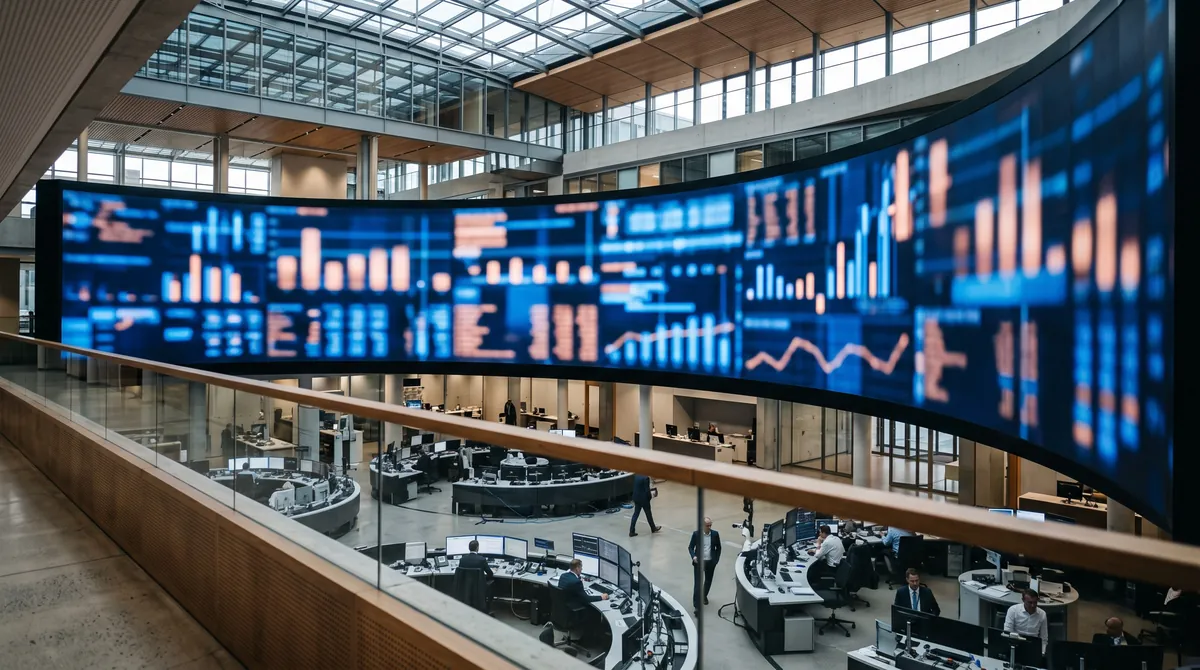

On an ordinary trading day, shares, bonds and funds worth billions of euros change hands on Germany’s stock exchanges. For investors it looks like a single click, but behind it lies a finely tuned system of rules, trading venues and supervision. This article explains how prices are formed on the exchange, which order types exist, who monitors trading and what happens between the order and the credit to your custody account.
A marketplace with fixed rules
A stock exchange brings together the buying and selling interests of many participants under fixed rules. The German Stock Exchange Act (Börsengesetz) describes exchanges as public-law institutions with partial legal capacity that regulate and monitor such multilateral systems. Establishing an exchange requires written authorisation from the exchange supervisory authority. This is what distinguishes an exchange from a private deal between two parties: the conditions are the same for everyone, prices are published and every transaction can be traced.
Trading mainly involves shares, bonds, funds and exchange-traded products such as ETFs, index funds that track a securities index. For companies, the exchange is a source of capital. For savers, it offers stakes in companies that they can sell again during trading hours, provided a buyer is found.
Primary market and secondary market
On the primary market, securities are put into circulation for the first time. In an initial public offering (IPO), a company offers its shares to the public for the first time; in a capital increase, an already listed company issues new shares. Either way, money flows to the company, which can use it to finance investments, acquisitions or debt reduction. A public offering generally requires a securities prospectus approved by a supervisory authority, in Germany the Federal Financial Supervisory Authority (BaFin).
Most daily turnover takes place on the secondary market, where investors trade already issued securities among themselves; the company receives no money from these trades. Even so, the secondary market matters to companies: only the prospect of selling shares again later makes them attractive to investors, and the current price shows how the market values a company. What such a valuation can rest on is explained in the article on reading a company balance sheet.
How a price is formed
At the heart of every exchange is the order book. It lists all buy orders with their maximum price and all sell orders with their minimum price. A trade is concluded as soon as a buy and a sell order meet on price. Price-time priority applies: the highest buy limits and the lowest sell limits come first, and where limits are equal, the earlier order is executed first. Large orders are therefore sometimes only partially filled.
The best available buying price is called the bid, the best selling price the ask (Geldkurs and Briefkurs in German). The difference, the bid-ask spread, shows how easily a security can be traded. For large, heavily traded shares it is usually narrow; for smaller stocks or in quiet phases it can be considerably wider.
To keep less sought-after securities tradable, market makers continuously quote binding buy and sell prices. On the Börse Frankfurt trading venue, specialists take on this role: they manage the order books of individual securities, quote prices continuously and are expected to keep the spread as narrow as possible. On the fully electronic Xetra platform, by contrast, orders are matched automatically.
Market, limit and stop orders
The order type determines how an order is executed. The main types at a glance:
- Market order (bestens or billigst in German): executed at the next available price, with no price limit.
- Limit order: buys at most or sells at least at a set price, otherwise it is not executed.
- Stop-loss: activated when a set price level is reached, then executed like a market order.
- Stop-limit: becomes a limit order at that level and may remain unexecuted.
- Validity: depending on the bank and venue, an order applies for the day only or until a chosen date.
The choice has consequences. A market order is executed quickly, but in hectic phases the price can differ markedly from the last price displayed. A limit protects against such surprises but may mean that no trade takes place at all. Nor does a stop-loss order ensure a particular selling price: it merely triggers an order at a given level.
Trading venues, trading hours and indices
The most important trading venue for German shares is the Frankfurt Stock Exchange (Frankfurter Wertpapierbörse), with the electronic Xetra platform and the Börse Frankfurt venue. Core trading hours on Xetra run from 9:00 to 17:30 Frankfurt time on working days, with an opening auction in the morning and a closing auction from 17:30. Since December 2025, private investors have also been able to trade on Xetra from 8:00 to 22:00 if their bank or broker takes part. Börse Frankfurt also trades from 8:00 to 22:00, with shorter hours for bonds.
There are also regional exchanges in several German federal states, other trading systems and direct over-the-counter trading with banks or market makers that execute orders for their own account. Since 1 July 2026, banks and brokers in Germany have been barred from accepting payment for routing client orders to a particular venue (payment for order flow).
Indices sum up the performance of the market in a single figure. The best-known German index is the DAX. Since 20 September 2021 it has comprised 40 companies instead of 30, while the MDAX was reduced from 60 to 50 constituents at the same time. An index is not itself a security but a calculated value; it only becomes tradable through products such as ETFs that track it.
From the order to the custody account
Private investors do not trade on the exchange directly but through a custody account (Depot) with a bank or broker, which is either admitted to trading itself or passes orders on to admitted participants. Once executed in the order book, the trade is concluded but not yet settled. In many exchange transactions, a central counterparty steps in between buyer and seller and takes on the risk that one side defaults.
The actual delivery, securities against cash, runs through a central securities depository in which the securities are recorded. In the EU this currently happens as a rule two business days after the trade date, known as T+2. From 11 October 2027 the period will shrink to one business day, T+1 for short. The position usually appears in the custody account on the trade date, but delivery against payment is only complete on settlement.
Investors face several kinds of cost: the order fee of the bank or broker, exchange fees depending on the venue, the bid-ask spread and, where applicable, custody fees. Banks must disclose all costs and incidental charges in good time before a purchase or sale.
| Best bid / ask | €20.00 / €20.04 |
|---|---|
| Bid-ask spread | €0.04 (around 0.2 %) |
| Buy order | 50 shares, limit €20.10 |
| Execution at the ask price | 50 × €20.04 = €1,002.00 |
| Assumed order fee | €5.00 |
| Amount debited from the account | €1,007.00 |
| Value if sold immediately at the bid | €1,000.00 |
| Settlement for a purchase on a Monday | Wednesday (T+2), from 11 October 2027 Tuesday (T+1) |
All figures are invented, and at least 50 shares are assumed to be offered at the ask price. The limit means the buyer pays no more than 20.10 euros per share. On an immediate resale, 7 euros would be missing: 2 euros from the spread and 5 euros in fees, before any selling fee.
Who monitors trading
In Germany, supervision is spread across several levels. The exchange supervisory authority of the federal state where an exchange has its seat ensures compliance with the Stock Exchange Act and the proper conduct of trading and settlement. Every exchange must also set up a trading surveillance office (Handelsüberwachungsstelle) as a separate body of the exchange, which records and evaluates all trading data and investigates irregularities.
BaFin is responsible nationwide for, among other things, the ban on insider dealing and market manipulation, and it supervises banks and investment firms. At European level, the European Securities and Markets Authority (ESMA) coordinates the work of the national supervisors, for example in the move to the shorter settlement period. Supervision does not protect against price losses, but it does ensure an orderly framework with traceable prices.
The quoted price is the price on which a buyer and a seller last agreed.
The stock exchange is therefore less mysterious than it seems: a marketplace with fixed rules where supply and demand find a price at every moment. Anyone who understands the order book, order types, settlement and costs can put price movements and contract notes into context more easily. The price alone says little about a company’s value; for that, annual reports and balance sheets are worth a closer look.
Frequently asked questions
Can private individuals trade directly on the stock exchange?
No, private investors trade through a custody account with a bank or broker. These institutions are either admitted to exchange trading themselves or pass the orders on to admitted trading participants. In the order form you usually choose the trading venue, the order type and, where applicable, a limit. Which trading venues and trading hours are available depends on the institution.
What does T+2 mean, and what changes in 2027?
T+2 means that an exchange trade is settled two business days after the trade date, in other words that the securities and the money are actually transferred. This is currently the norm in the EU. From 11 October 2027, one business day, T+1 for short, will apply to trades on trading venues. For investors this mainly means that money and securities are booked definitively sooner.
Why does the execution price differ from the price displayed?
The price displayed is usually that of the last trade. Your order, however, is executed at the best available price in the order book, so generally at the ask price when buying and at the bid price when selling. In volatile phases or with thinly traded securities, the difference can be noticeable. A limit sets the maximum price you pay or the minimum price you receive.
Who supervises stock exchange trading in Germany?
Several bodies share the task. The exchange supervisory authority of the relevant federal state supervises the exchange under the German Stock Exchange Act, while the exchange’s trading surveillance office continuously evaluates trading data. BaFin pursues insider dealing and market manipulation, among other things, and supervises banks and investment firms. At European level, ESMA coordinates the work of the national supervisors.
Terms
- Order book
- Electronic register of all open buy and sell orders for a security, sorted by price and time of entry.
- Bid-ask spread
- Difference between the best buy offer (bid) and the best sell offer (ask) for a security, often simply called the spread.
- Central securities depository
- Institution that records securities centrally and settles the delivery of securities against cash between the banks involved.
Sources
- Handelszeiten und -kalender (in German)Deutsche Börse
- DAX welcomes ten new membersDeutsche Börse
- ESMA calls on firms to finalise preparations ahead of T+1 settlement deadlinesESMA
- Börsengesetz, § 7 Handelsüberwachungsstelle (in German)Bundesministerium der Justiz und für Verbraucherschutz
- Securities transactionsFederal Financial Supervisory Authority (BaFin)
Image: illustration, created with AI.