Investmentsmaidav Basics
Property as an Investment: Costs, Opportunities and Risks
Rental income, value growth, leverage: what a let property can deliver and which costs investors should realistically plan for in advance.
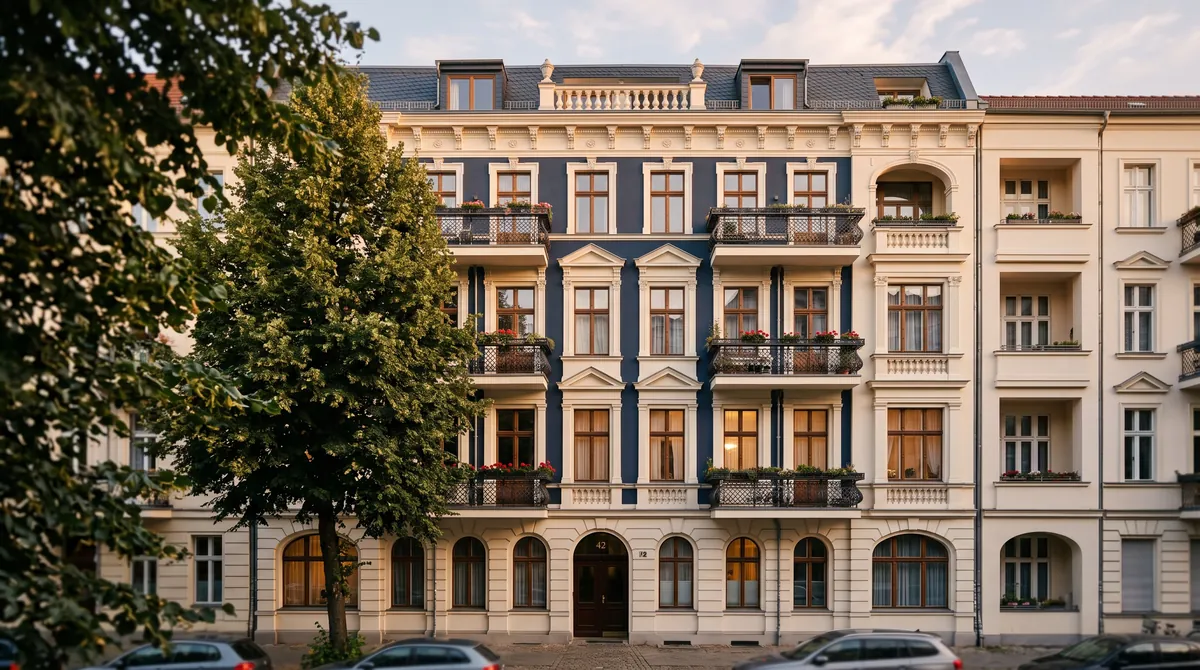

A let flat combines regular income with a tangible real asset, and financing part of it with a loan can increase the return on the equity invested. At the same time, a property ties up a great deal of capital, generates costs before the first rent comes in and needs looking after. This article shows which purchase costs and running expenses you should realistically plan for, how gross and net rental yields are calculated, what role interest and taxes play and which alternatives exist.
What a let property can deliver
The most important source of return is the rent. It comes in every month, can be adjusted over time within the limits of tenancy law and turns the property into a source of income that does not depend on the stock market. Added to this is the prospect of an increase in value over long periods, especially in locations with stable demand. As a real asset, the flat also stands for a tangible value that does not hinge on a single company.
Another lever is financing. If you pay only part of the purchase price from your own funds and finance the rest with a loan, you can acquire a larger property with comparatively little equity. If the property's return is higher than the interest rate on the loan, the return on the equity invested rises. This effect works in both directions, however, as the section on financing shows.
Plan for purchase costs in advance
On top of the purchase price come incidental purchase costs, which fall due immediately and do not add to the value of the property. In Germany, the three largest items are:
- Real estate transfer tax (Grunderwerbsteuer): each German federal state sets its own rate, which ranges from 3.5 to 6.5 per cent of the purchase price.
- Notary and land register: the fees follow the German Court and Notary Fees Act and rise with the purchase price; as a rough guide, around 1 to 2 per cent.
- Estate agent: since 23 December 2020, consumers buying a flat or a single-family house may be charged at most half of the commission if the seller or both parties engaged the agent.
The brokerage rule under Sections 656c and 656d of the German Civil Code (BGB) does not apply to blocks of flats. Depending on the federal state and whether an agent is involved, incidental costs therefore range from a mid single-digit to a low double-digit percentage of the purchase price. The property first has to earn this sum back over the years.
Running costs that stay with the owner
Many operating costs, such as property tax, water, refuse collection or buildings insurance, can be passed on to tenants under the German Operating Costs Ordinance (Betriebskostenverordnung) if the tenancy agreement provides for this. Management costs and the costs of maintenance and repair, by contrast, are expressly not operating costs (Section 1 of the Operating Costs Ordinance) and remain with the owner. For a flat held under German condominium ownership (Eigentumswohnung), these include the property manager's fee and the contributions to the owners' association's maintenance reserve.
On top of that come reserves for repairs inside your own flat, for example for the bathroom, kitchen or flooring, and the risk of vacancy. Between two tenancies, weeks or months can pass without any income while the loan instalments and the monthly service charge (Hausgeld) keep running. A realistic calculation therefore allows for a buffer instead of assuming uninterrupted letting. You can estimate how a monthly reserve builds up over the years with the compound interest calculator.
Gross and net rental yield
The simplest measure is the gross rental yield: the annual basic rent, excluding service charges (Kaltmiete), divided by the purchase price. It is useful for a first comparison but leaves out incidental and running costs. The net rental yield is more meaningful. For this, the non-recoverable costs and reserves are deducted from the annual basic rent, and the result is set against the purchase price including incidental costs. Neither figure takes account of financing, taxes or changes in value.
| Purchase price | €300,000 |
|---|---|
| Incidental purchase costs (assumption: 10 %) | €30,000 |
| Total investment | €330,000 |
| Annual basic rent (€1,000 a month) | €12,000 |
| Gross rental yield (12,000 / 300,000) | 4.0 % |
| Non-recoverable costs and reserves per year | €2,400 |
| Annual net income | €9,600 |
| Net rental yield (9,600 / 330,000) | around 2.9 % |
All figures are invented, rounded assumptions. The gap between 4.0 and around 2.9 per cent shows how much incidental and running costs reduce the yield, even before interest and taxes are taken into account.
Leverage and interest rate risk
Financing amplifies the result. A simplified thought experiment: if a property earns three per cent on the total capital invested before financing costs and the loan costs two per cent, the owner keeps the difference on the loan-financed portion, and the return on equity rises. If, however, the loan costs four per cent, the effect is reversed and the equity has to cover the gap.
With property loans, the interest rate is usually fixed for a set period, known in Germany as the fixed-rate period (Zinsbindung). If it ends before the loan has been repaid, follow-up financing is arranged on the terms prevailing at that time. If market rates are higher by then, the monthly burden rises, even though nothing has changed about the rent or the property. Regardless of the fixed-rate period, borrowers can terminate a loan with a fixed borrowing rate ten years after it was paid out in full, giving six months' notice (Section 489 of the German Civil Code).
Tax effects for landlords
In Germany, rental income is taxed as income from letting and leasing, and expenses such as interest on the loan, management, maintenance expenditure and depreciation reduce it. Only the building is depreciated, not the land. Straight-line depreciation for residential buildings is 2.5 per cent a year for buildings completed before 1925, 2 per cent for those completed between 1925 and the end of 2022, and 3 per cent for those completed from 2023 onwards (Section 7(4) of the German Income Tax Act). For new residential buildings on which construction began between October 2023 and September 2029, declining-balance depreciation of 5 per cent of the residual value each year is available as an alternative.
When you sell, the holding period counts. If no more than ten years pass between acquisition and sale, a gain is taxed as a private sale transaction at your personal income tax rate; after that, it is tax-free for property held as a private asset (Section 23 of the German Income Tax Act). Exceptions to this ten-year holding period apply to owner-occupied homes. If you sell within the period, depreciation already claimed increases the taxable gain because it reduces the acquisition costs.
Alternatives without a property of your own
If you want to take part in the property market without becoming a landlord yourself, there are several routes. Open-ended real estate funds spread their capital across many properties; units can only be returned to the fund company after a minimum holding period of 24 months and with a redemption notice period of twelve months (Section 255 of the German Capital Investment Code, KAGB). Property shares are stakes in companies that own, develop or manage real estate, and they fluctuate with the stock market.
REITs (real estate investment trusts) are listed property companies with a high distribution requirement. A German REIT stock corporation must distribute at least 90 per cent of its annual net profit and in return is exempt from corporation tax and trade tax. These variants are accessible with smaller amounts but offer no direct influence over the property or the tenants. The article ETFs, individual shares and bonds compared explains how exchange-traded building blocks differ in principle.
A property's return is what remains after incidental costs, reserves and interest, not before them.
A let property can provide stable income and a solid real asset over many years, especially when location, condition and financing fit together. Its result, however, depends less on the purchase price alone than on the complete calculation, including incidental costs, reserves, vacancy, the fixed-rate period and taxes. If you account for these items honestly in advance, you can weigh the opportunities and risks realistically.
Frequently asked questions
Which costs can be passed on to tenants?
Recoverable costs are operating costs within the meaning of the German Operating Costs Ordinance, such as property tax, water, refuse collection, cleaning of the building or buildings insurance, provided the tenancy agreement allows for it. Management costs and maintenance and repair are expressly excluded and remain with the landlord. They are therefore included in the calculation of the net rental yield.
Who pays the estate agent when you buy a flat?
When consumers in Germany buy a flat or a single-family house, the rule since 23 December 2020 is this: if the agent works for both sides, both pay the same amount. If only the seller engaged the agent, at most half may be passed on to the buyer, and only after the seller has paid their share. This rule does not apply to blocks of flats.
Is the gain on selling a let flat tax-free?
If more than ten years pass between purchase and sale, the gain on a property held as a private asset is tax-free in Germany. Within this period it counts as a private sale transaction and is taxed at your personal rate, with depreciation already claimed increasing the gain. Exceptions apply to owner-occupied homes.
How does an open-ended real estate fund differ from owning a flat?
An open-ended real estate fund spreads its capital across many properties and takes care of letting and management. In return, fund costs are charged, and units can only be returned to the fund company after a minimum holding period of 24 months and with twelve months' notice. There is no leverage from a loan of your own and no direct influence over the property.
Terms
- Net rental yield
- Annual basic rent less non-recoverable costs and reserves, in relation to the purchase price including incidental purchase costs.
- Follow-up financing
- New financing of the outstanding balance of a property loan once the agreed fixed-rate period has ended (Anschlussfinanzierung).
- Maintenance reserve
- A sum saved by a German owners' association for future repairs to the jointly owned parts of the building (Erhaltungsrücklage), formerly called Instandhaltungsrücklage.
Sources
- Grunderwerbsteuer, Steuersätze der Länder (in German)Finanzämter des Landes Brandenburg
- Section 656c German Civil Code, Fee claim in the case of the broker working for both partiesBundesministerium der Justiz, gesetze-im-internet.de
- § 1 Betriebskostenverordnung, Betriebskosten (in German)Bundesministerium der Justiz, gesetze-im-internet.de
- § 7 Einkommensteuergesetz, Absetzung für Abnutzung oder Substanzverringerung (in German)Bundesministerium der Justiz, gesetze-im-internet.de
- § 23 Einkommensteuergesetz, Private Veräußerungsgeschäfte (in German)Bundesministerium der Justiz, gesetze-im-internet.de
Image: illustration, created with AI.